

Featured partner offer
Make room for a brighter morning
The Carex Day-Light Classic Plus combines a large panel with adjustable height and angle. Compare it with the compact lamps and sunrise clocks below to find the format that fits your routine.
On the partner’s website
Our light therapy shortlist
Four bright-light lamps and two sunrise alarm clocks, compared by format and everyday use. The Philips clocks are for gradual waking; they are not 10,000-lux therapy light boxes.
Large adjustable light box

Carex Day-Light Classic Plus
On the partner’s website
Simple tablet-style lamp
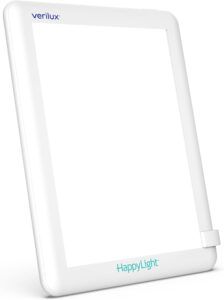
Verilux HappyLight Lucent
On Amazon
Colored sunrise and sunset
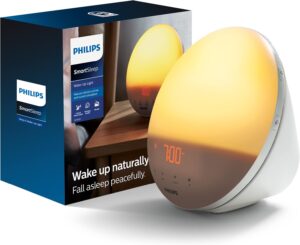
Philips SmartSleep Wake-Up Light HF3520
On Amazon
Simpler sunrise alarm
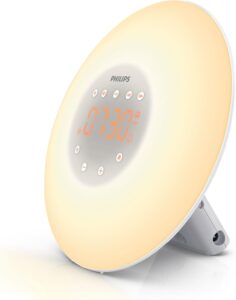
Philips Wake-Up Light HF3505
On Amazon
Compact personal light
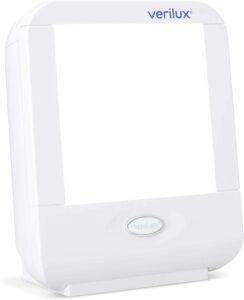
Verilux HappyLight Compact
On Amazon
Adjustable light for a narrow desk
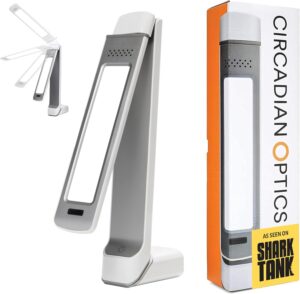
Circadian Optics Lumos 2.0
On Amazon
A closer look at all six options
Large adjustable light box
Carex Day-Light Classic Plus
A practical option when you want a broad light panel and room to adjust its height and angle. Its size suits a dedicated table or desk better than a crowded bedside surface.
Pros
- Large 16 × 13-inch light panel
- Adjustable height and panel angle
- Separate bright-light and task-light settings
Cons
- Takes up more space than the compact lamps
- Corded design is better suited to a regular home setup
Read more about this pick
Carex lists 10,000 lux at a distance of 12–14 inches for the Classic Plus. Match the current model and setup instructions on the partner’s site before ordering.
The broad panel is the main reason to consider this design; portability is the tradeoff.
On the partner’s website
Simple tablet-style lamp
Verilux HappyLight Lucent
A straightforward choice for a small workspace. The one-button design keeps setup simple, while the detachable stand lets you position the panel vertically or horizontally.
Pros
- Simple one-button operation
- Detachable stand for two orientations
- Slim format is easy to move between rooms
Cons
- No built-in dimming control
- Rated brightness depends on sitting at the specified distance
Read more about this pick
The Lucent is model VT22. Verilux lists 10,000 lux at 6 inches, so check whether that positioning fits your desk rather than comparing the lux headline alone.
This is a bright-light lamp, not a sunrise alarm clock.
On Amazon
Colored sunrise and sunset
Philips SmartSleep Wake-Up Light HF3520
Choose this for a gradual bedside wake-up routine rather than a dedicated light-therapy session. It combines a colored sunrise, sunset dimming and a choice of wake-up sounds.
Pros
- Colored sunrise and sunset simulation
- Five natural wake-up sounds and FM radio
- Adjustable bedside-light brightness
Cons
- Not a 10,000-lux therapy light box
- More settings to manage than a basic alarm clock
Read more about this pick
The HF3520/60 is a sunrise alarm clock. Its gradual light and sound features serve a different purpose from the bright-light boxes in this guide.
Confirm the model suffix, plug and seller’s terms for your region.
On Amazon
Simpler sunrise alarm
Philips Wake-Up Light HF3505
A simpler Philips option for waking to gradually increasing light. It includes two natural sounds and FM radio, with fewer light features than the HF3520.
Pros
- Gradual sunrise-style wake-up light
- Two natural sounds plus FM radio
- Tap-to-snooze function
Cons
- No sunset simulation
- Older model: check availability and seller support
- Not a substitute for a bright-light therapy box
Read more about this pick
The HF3505/60 offers yellow sunrise simulation and ten brightness settings. Philips marks this model as discontinued on its support site, so check the condition and return policy of any marketplace offer.
On Amazon
Compact personal light
Verilux HappyLight Compact
A small, uncomplicated lamp for a desk or kitchen table. The compact footprint and simple switch appeal if you prefer a personal light without extra controls.
Pros
- Compact tabletop format
- Simple on/off operation
- UV-free bright white light
Cons
- Smaller light surface than the Carex
- Limited controls compared with adjustable-brightness models
Read more about this pick
This is the HappyLight Compact listing linked in our original guide (ASIN B00K08ZDBI). Check the seller’s current model details and the included instructions, particularly the distance needed for its stated brightness.
On Amazon
Adjustable light for a narrow desk
Circadian Optics Lumos 2.0
The articulated design is useful when desk space is limited and you want to adjust the light panel’s position. Three brightness levels offer more control than a simple on/off lamp.
Pros
- Adjustable rotating light panel
- Narrow base preserves desk space
- Three brightness levels
Cons
- Small panel requires careful positioning
- Check the height and reach against your workspace
Read more about this pick
The linked Lumos listing describes a rotating panel, a weighted base and 10,000-lux output. Follow the supplied distance and positioning instructions; the brightness at your eyes changes with distance.
On Amazon
How to choose a light therapy lamp
Start with the job you want the light to do. A bright-light box is designed for a session while you are awake. A sunrise alarm slowly brightens your bedroom before your alarm time. This guide includes both because they appeared in our original selection, but they should not be treated as the same kind of product.
Choose the right type of light
For a dedicated bright-light setup, compare the Carex, HappyLight Lucent, HappyLight Compact and Circadian Optics Lumos. Their main differences are panel size, positioning and controls.
If your priority is a gradual wake-up, compare the two Philips clocks instead. The HF3520 adds colored sunrise and sunset features; the HF3505 offers a simpler sunrise with sound and radio. Neither is presented here as a replacement for a therapy light box.
Compare brightness at a usable distance
A headline lux figure only helps when you know the measurement distance. Carex specifies 10,000 lux at 12–14 inches for the Classic Plus; Verilux specifies that level at 6 inches for the Lucent. Check whether the required position works beside your laptop, breakfast or book.
Use the instructions for the exact model you buy. Moving a lamp farther away changes the amount of light reaching you; a small, bright panel and a large panel do not necessarily give you the same freedom to move.
Match the panel and controls to your space
A large adjustable panel such as the Carex makes sense if you can leave a dedicated setup in place. The slim Lucent and small HappyLight Compact suit spaces where a full-size light box would feel cumbersome. The Lumos trades a broad panel for a narrow base and an adjustable head.
Think about cable reach, storage and where your eyes will be while seated. If you want to change brightness with a control, check that feature explicitly: the Lucent uses a simple on/off button, while the Lumos offers three brightness levels.
Check the model, seller and instructions
Several products in this selection are established models. Match the product name and model number to the offer, and check the condition, included power supply and return terms before buying. Philips lists the HF3505 as discontinued, so marketplace support and availability deserve particular attention.
For seasonal depression, discuss treatment with a health care provider. NIMH describes UV-filtered bright-light boxes as a treatment for winter-pattern seasonal affective disorder and notes that some eye conditions and medicines require medical supervision. A shopping comparison cannot determine the right treatment or schedule for you.
Read more: NIMH guidance on seasonal affective disorder.
How we put this guide together
We retained the six products from our original light therapy guide and compared their published features, product formats and setup requirements. This is a research-based comparison; we have not tested these lamps hands-on. The best-for labels describe practical uses rather than clinical rankings.
Prices, stock and seller terms can change. Use the buttons to check the current offer, and confirm the instructions for the exact model supplied.
Product references: Carex Classic Plus, Verilux Lucent, Philips HF3520 and Philips HF3505 support. Compact and Lumos details were checked against their linked Amazon listings.
Frequently asked questions
Is a sunrise alarm the same as a light therapy lamp?
No. A sunrise alarm gradually brightens before your alarm time. A bright-light box is designed for use while you are awake. The Philips clocks in this guide should not be treated as substitutes for a 10,000-lux therapy box.
Which option works best on a small desk?
Look at the HappyLight Lucent for a slim tablet shape, the HappyLight Compact for a small tabletop lamp, or the Lumos for a narrow base and adjustable panel. Compare their required operating distance with the space you actually have.
Does 10,000 lux mean every lamp works at the same distance?
No. Check the manufacturer’s measurement distance for each model. For example, Carex lists 12–14 inches for the Classic Plus and Verilux lists 6 inches for the Lucent. Positioning matters as much as the headline number.
Can I use an ordinary desk lamp instead?
Do not assume a normal desk bulb provides the same light level or UV filtering as a purpose-built bright-light box. Choose equipment and a routine with guidance appropriate to your needs, and follow its instructions.
How long should I use a light therapy lamp?
Follow the instructions for your exact model and any advice from your health care provider. The right timing and duration depend on the device and your circumstances; this comparison does not prescribe a treatment schedule.
Are these models still available?
Availability varies by model and seller. We have kept the original six products and their existing affiliate destinations. The HF3505 is an older discontinued model, so check condition, support and return terms before ordering.