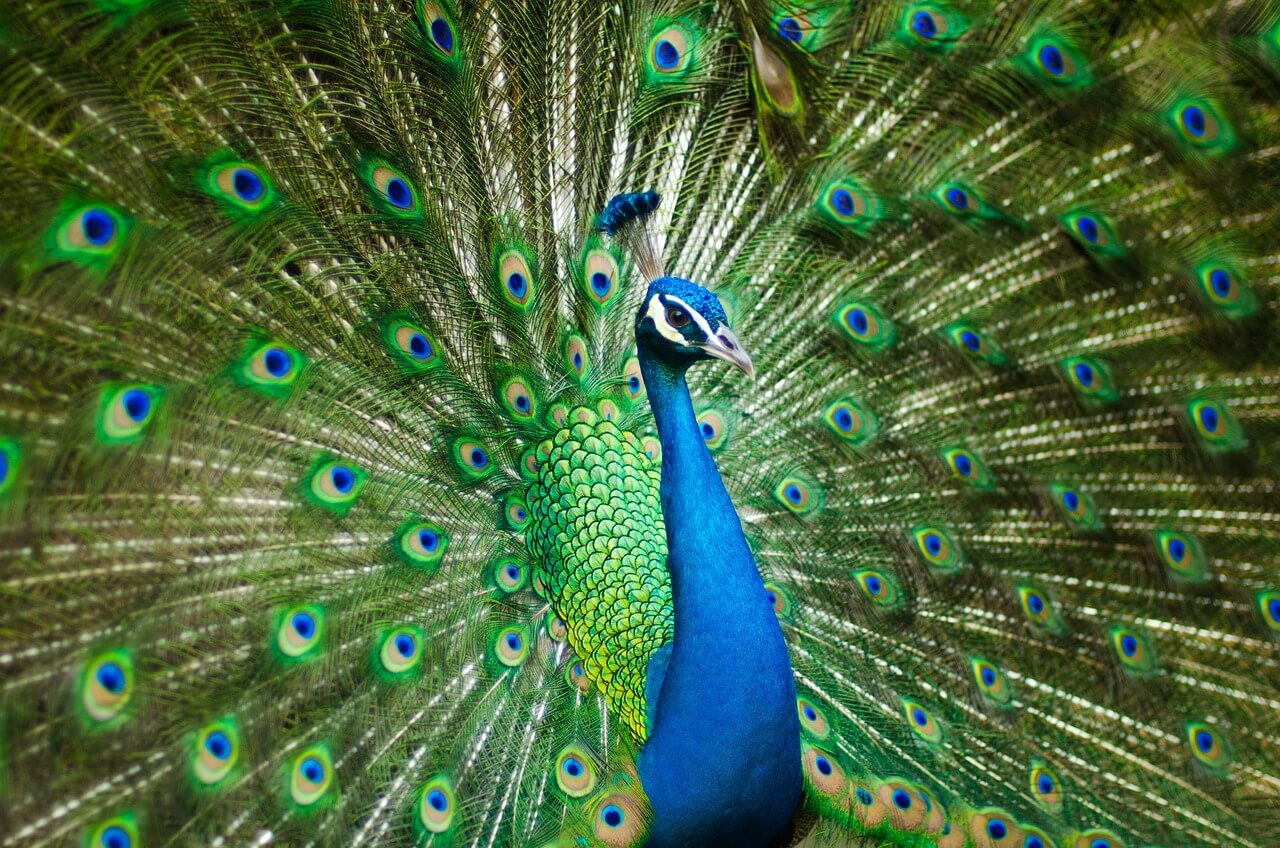
There is no performance in the natural world quite like it. The male peacock — still, patient, almost invisible in his green-blue iridescence — pauses, and then, with a movement that seems both deliberate and inevitable, raises his extraordinary tail into a shimmering arc of color and light. A hundred eyes stare outward from the feathers. The sun catches the iridescent blues and greens and golds. The entire display trembles with a barely contained magnificence. And the message could not be clearer or more direct: this is who I am, and I am not afraid for you to see it.
In the language of spirit animals, the peacock carries a teaching that is at once simple and profoundly challenging: show yourself. Not the edited version of yourself, not the self that has been carefully trimmed and softened and made smaller to fit the spaces others have designated for you, but the full, unguarded, magnificently impractical truth of who you actually are — your gifts, your beauty, your depth, your color, your light. The peacock does not display its tail to please anyone. It displays because the display is its nature, because the beauty is real and belongs to the world, and because there is no spiritual integrity in hiding what you genuinely are.
The peacock spirit animal is equally a symbol of divine vision, immortality, and the all-seeing eye of the spirit — carrying within the extraordinary ocelli of its tail feathers one of the most ancient and most universally recognized symbols of spiritual watchfulness and awakened perception. It is also a creature of remarkable integrity and inner strength: the peacock’s beauty is not merely ornamental but functional, earned, and renewed each year through the complete shedding and regrowing of its entire magnificent tail — a process of radical, literal renewal that makes the peacock one of the most powerful symbols of rebirth and resurrection in the entire natural world.
Peacock Spirit Animal Meaning
The Peacock Spirit Animal is among the most sacred and most widely revered birds in the history of human spiritual life. Unlike many spirit animals whose significance is concentrated in a particular region or tradition, the peacock has been honored with deep devotion in virtually every civilization that encountered it — from the temples of ancient India to the imperial courts of China, from the mosaic-covered walls of early Christian basilicas to the golden thrones of Persian kings. Across all of these traditions, the peacock’s core spiritual meaning remains strikingly consistent: it is a creature of divine beauty, immortal vision, sacred protection, and the extraordinary invitation to stand fully and openly in one’s own truth.
Historical Significance
The peacock’s spiritual history is inseparable from its visual impact. In a world before photography, before cinema, before the saturated color of the modern visual environment, the peacock’s tail — with its impossible iridescent blues and greens, its perfectly symmetrical ocelli, its sheer scale and trembling beauty — was genuinely one of the most astonishing things a human being could encounter. Ancient peoples did not merely admire the peacock. They were awestruck by it. And that quality of awe, reliably produced in every culture that encountered this bird, consistently translated into the peacock’s elevation to a status of sacred and divine significance.
In ancient Babylon, the peacock was associated with the Tree of Life — the sacred symbol at the center of the world from which all living things radiated outward. Two peacocks flanking the Tree of Life was one of the most common and most powerful sacred images in Mesopotamian art, representing the dual nature of all reality — the seen and the unseen, the material and the spiritual, the mortal and the divine — and the beautiful, balanced harmony between them. This image was so resonant that it traveled through Persian, Byzantine, and early Christian art for thousands of years, arriving in the great mosaic traditions of medieval Europe still carrying its original message of sacred abundance and divine order.
In early Christianity, the peacock was adopted as one of the most important symbols of immortality and the resurrection of the soul. The reason was biological as much as theological: the peacock sheds its entire magnificent tail each year and regrows it in full glory — a living, visible demonstration of the principle that apparent loss and stripping away is always the prelude to renewal, and that what appears to die is always, in the fullness of time, gloriously reborn. Early Christian artists decorated the walls and floors of basilicas and catacombs with peacock imagery, placing the bird beside the fountains of paradise and the gardens of eternal life as a sign of the soul’s deathlessness. The peacock’s flesh was also believed, in early Christian tradition, to be incorruptible — a belief that Pliny the Elder recorded and that gave the peacock an additional association with the purity and permanence of the sanctified soul.
Cultural Representation
The peacock’s spiritual significance reaches perhaps its greatest depth and elaboration in Hinduism, where it is the sacred bird of multiple major deities and holds a place of extraordinary reverence in the divine mythology of the subcontinent. The peacock is the vehicle — the divine mount — of Lord Murugan, the god of war and victory, who rides upon the back of a peacock named Paravani. This association represents the conquest of ego, the transformation of the dark and destructive forces symbolized by the peacock’s ability to kill snakes, and the elevation of the warrior spirit toward its highest and most spiritual expression. The peacock is also associated with Lord Krishna, who wears a single peacock feather in his crown as a symbol of divine beauty, creative play, and the sacred enchantment that infuses all of existence. And the peacock walks beside Lakshmi, the goddess of prosperity, beauty, and compassionate fortune — connecting it to the energies of abundance and the generous, loving face of the divine feminine.
In Chinese imperial tradition, the peacock was among the most prestigious of all birds — a symbol of dignity, nobility, and the triumph of good over evil. The peacock was associated with Guan Yin, the goddess of compassion and mercy, whose capacity to transform poison into beauty and suffering into wisdom is reflected in the peacock’s legendary ability to consume venomous snakes and transform their toxins into the radiant color of its feathers. This mythological detail — that the peacock’s extraordinary iridescence is literally made from the venom of its prey — is one of the most spiritually rich in all of animal symbolism: the understanding that beauty can be made from what was dangerous, that the darkest experiences can be transformed, through the alchemy of spiritual wisdom, into something that illuminates and heals.
In Persian mythology, the peacock was the guardian of the divine throne — depicted on the thrones of kings and emperors as the ultimate symbol of royal authority and spiritual watchfulness. The Peacock Throne of the Mughal emperors, one of the most famous objects in the history of the world, took its name and its imagery from this tradition, reflecting the belief that the peacock’s all-seeing eyes were the perfect symbol of a ruler whose spiritual vision extended beyond the ordinary and whose authority was consecrated by the divine.
Related: How to Find Your Spirit Animal
Common Interpretations in Dreams
Dreaming of a peacock is one of the most visually striking and spiritually significant dream experiences available, and its meaning is almost universally positive — a message from the deeper self and from the spiritual dimension about the themes of self-expression, authentic visibility, renewal, and the extraordinary gifts that wait to be claimed when we stop hiding what we genuinely are.
A peacock displaying its full tail in a dream is among the clearest possible signals that the dreamer is being called — by the soul, by the spirit, by the deeper intelligence that speaks through dreams — to step fully into their own authentic self-expression. Something in the dreamer’s life is ready to be revealed, shared, or brought into the open. A peacock walking calmly and regally through a dream speaks to dignity, grace, and the invitation to carry oneself with the full authority of one’s own inherent worth. A peacock with its tail folded — beautiful but unexpressed — may reflect the dreamer’s current relationship with their gifts: present, genuine, and extraordinary, but held back by fear, doubt, or the mistaken belief that full self-expression is somehow inappropriate.
Personal and Emotional Connection
Those who feel personally connected to the peacock spirit animal tend to be individuals of genuine inner beauty and natural creative gifts who are navigating a profound and sometimes difficult relationship with visibility — with the question of whether it is truly safe and truly right to be seen in their fullness. Peacock totem people are often extraordinarily sensitive to the aesthetic dimension of experience: to beauty in all its forms, to the emotional resonance of color and design and self-expression, to the ways in which the outer appearance of things communicates something true and essential about their inner nature.
They tend also to be people of deep integrity — individuals for whom the alignment between inner truth and outer expression is not merely preferable but essential, for whom any form of pretense or inauthenticity creates a kind of inner dissonance that is genuinely painful. The peacock, whose display is not performance but pure, unmediated self-expression, is the perfect totem for those who are learning to live from this same quality of wholeness — for those who are discovering that the most beautiful and the most powerful thing they can offer the world is simply, completely, and without reservation, themselves.
Related: What is my spirit animal by birthday
Spiritual and Emotional Significance
The Peacock Spirit Animal carries what may be the most visually magnificent and the most personally confronting of all spirit animal teachings: the invitation to stand in your light — not modestly, not tentatively, not with the self-conscious apology that has been trained into those who were taught that radiance is arrogance and that genuine self-expression is vanity. The peacock’s display is not vanity. It is truth. It is the full, unreserved expression of what this creature genuinely is — and it is one of the most beautiful things in the natural world precisely because of that completeness, that lack of apology, that absolute willingness to be entirely, magnificently, and openly itself.
Personal Growth and Development
The peacock spirit animal calls its person toward a specific and deeply personal form of growth: the courage of authentic visibility. For many people, this is genuinely difficult work — more difficult, in some ways, than the shadow work of the bat or the surrender of the frog — because it requires not the willingness to enter the dark but the willingness to step into the light. To be seen. To display. To allow the world access to what you have been protecting by keeping it hidden.
The peacock’s teaching here is precise and non-negotiable: hiding your gifts is not humility. Humility is the accurate recognition of your place in the whole — and an accurate recognition of your place in the whole includes the honest acknowledgment of your genuine gifts, your real beauty, your actual creative power. To deny these things, to minimize them, to keep them folded away in the name of not seeming too much — this is not spiritual virtue. It is a form of dishonesty, and the peacock’s medicine calls it out with the full authority of the most beautiful bird in the world spreading its tail in the midday sun.
Healing and Protection
The peacock’s healing gifts are rooted in its extraordinary relationship with transformation through beauty. The Guan Yin tradition — the peacock who consumes the venom of snakes and transforms it into the radiance of her feathers — is perhaps the most powerful healing metaphor this spirit animal carries: the understanding that what has been most toxic in our experience can become, through the alchemy of genuine spiritual work, the very source of our most luminous beauty. Many who carry the peacock as their totem have been through experiences of genuine darkness — betrayal, loss, the particular pain of having their authentic self rejected or diminished — and have found, in the working-through of those experiences, that the gifts they now carry are inseparable from the wounds that shaped them.
Protectively, the peacock’s thousand eyes — drawn from the Greek mythological tradition of Argus Panoptes, whose watchful gaze Hera immortalized in the peacock’s tail — are among the most potent protective symbols in the entire spiritual vocabulary. The evil eye tradition, in which the peacock feather’s ocellus is understood as a protective talisman that catches and repels negative energy before it can reach its target, is one of the most widespread and most enduring protective symbols in human culture, appearing from the Mediterranean to South Asia to the Americas. Working with peacock medicine means developing a corresponding quality of spiritual vigilance — an awareness so acute and so comprehensive that nothing harmful can approach undetected.
Peacock Totem and Power Animal
As a totem animal, the peacock represents the soul that has done the work of genuine self-knowledge and has arrived at a place of deep, stable, luminous self-acceptance — not the brittle self-approval that depends on others’ praise, but the rooted inner knowing of a being that has looked at itself honestly, has found what is genuinely beautiful and genuinely needing work, and has made peace with the full truth of what it is. Those who carry the peacock as their lifelong totem tend to move through the world with a quality of presence that draws others to them — not through effort or performance, but through the natural magnetism of a soul that is truly, completely at ease with itself.
Finding Your Peacock Totem
Recognizing the peacock as your totem animal often involves a deep, long-standing sensitivity to beauty — in all its forms, not merely the obvious or conventional. Peacock totem people tend to be those for whom aesthetics carry genuine spiritual significance, for whom the way something looks, sounds, moves, or feels communicates something essential and true about its inner nature. They are often gifted in the creative arts, in design, in any field that requires the capacity to make something both beautiful and meaningful — to give form to what is real and important.
Signs that the peacock may be your totem include: a recurring sense of being called to greater visibility and self-expression while simultaneously feeling the pull of self-concealment; a deep resonance with themes of renewal and the annual shedding and regrowing of one’s own metaphorical tail; encounters with peacocks at significant life moments; and a lifelong understanding, even when it has been difficult to act on, that your truest and most powerful offering to the world is the complete, unedited truth of who you are.
Embracing the Peacock Energy
To embrace the energy of the peacock spirit is to make a conscious, daily commitment to authentic self-expression — to the practice of showing up in your fullness rather than in your edited version, in your genuine color rather than in the muted palette that others’ discomfort has sometimes suggested is more appropriate. This is not about performance or display for its own sake. The peacock does not display its tail to an empty forest. It displays because the display is genuine — because the beauty is real, the moment is right, and the world is waiting to be dazzled by what has always been there.
Embracing the peacock also means developing a conscious relationship with renewal — with the understanding that the annual shedding of the peacock’s tail, which leaves it temporarily stripped and vulnerable, is not a diminishment but a preparation, a necessary release of what has served its purpose so that something even more magnificent can grow in its place. For those working with peacock medicine, this means befriending the cycles of loss and regrowth that are woven through every human life — the endings that feel like stripping away and that are, in truth, the precise conditions under which something more beautiful becomes possible.
Common Peacock Symbols in Dreams
Peacocks in dreams are among the most visually arresting and spiritually significant of all dream images, arriving with a weight of beauty and meaning that rarely leaves the dreamer unmoved. Their presence in dreams almost always speaks to the themes of self-expression, authentic visibility, spiritual vision, and the extraordinary gifts that become available when we stop asking permission to be fully ourselves.
Positive Aspects:
- Full display: A peacock fanning its tail in complete, trembling beauty is one of the most unambiguous positive messages available in the dream world — a direct call from the soul to step forward, to be seen, to bring your full gifts into expression without further delay or self-censorship.
- Divine protection: A peacock standing guard — at a threshold, beside the dreamer, with its thousand eyes open and watchful — is a profound symbol of spiritual protection, the assurance that a force of extraordinary vigilance and beauty is holding you safe.
- Spiritual vision: A peacock whose eyes meet the dreamer’s directly carries the invitation to develop or trust the intuitive and visionary gifts that are seeking expression — the inner seeing that goes beyond ordinary perception to the deeper truth of things.
- Abundance and beauty incoming: A peacock walking calmly through a beautiful garden or natural setting speaks to the movement of abundance, beauty, and blessing into the dreamer’s life — a sign that what has been hoped for is drawing close.
Negative Aspects:
- Hidden gifts: A peacock with its tail folded or concealed often reflects the dreamer’s current suppression of their authentic gifts — a gentle but urgent message that what is being kept hidden is needed, by the world and by the soul, in its full expression.
- Pride misapplied: A peacock in a dream that carries a quality of vanity or empty performance may be the unconscious reflecting a place where the drive for external validation has overtaken the deeper authenticity that is the peacock’s true gift — a call to return to genuine self-expression rather than performing for approval.
- Fear of visibility: A dream in which the peacock cannot or will not display its tail often reflects the dreamer’s own fear of being seen — the anxiety about what will happen if they allow their full beauty, talent, and truth to be visible to others.
Specific Dream Scenarios:
- A white peacock: One of the rarest and most spiritually significant dream symbols — purity, illumination, divine grace, and the luminous quality of a soul that has arrived at genuine transparency and wholeness. An exceptionally auspicious omen.
- A peacock feather: The all-seeing eye in close-up — an invitation to deepen your intuitive vision, to look more carefully at a situation or relationship, or to trust what you have been perceiving beneath the surface.
- A peacock’s cry: The peacock’s call, which is loud, distinctive, and completely at odds with its visual splendor, is in dreams a signal to use your voice — to speak your truth, to make your presence known in a situation where you have been silent too long.
- A golden peacock: Extraordinary abundance, spiritual royalty, and the full manifestation of one’s highest gifts — a dream that may accompany a significant creative breakthrough or a moment of genuine spiritual arrival.
- A peacock molting: The shedding of the tail in a dream signals the end of one significant life chapter and the necessary stripping-away that precedes the growth of something even more extraordinary. A sign to release with trust rather than to grieve.
Intuition and Visions:
Encountering a peacock during meditation or in a waking vision is one of the most visually stunning and spiritually significant experiences available to the seeker. Its message, regardless of the specific form the encounter takes, is almost always a version of the same essential invitation: you are more beautiful than you know, more gifted than you allow yourself to believe, and the world is waiting — with genuine patience and genuine readiness — for you to finally let it see.
Integrating with the Natural World
Understanding the peacock spirit animal draws us into a contemplation of beauty as a spiritual force — not beauty as vanity or decoration, but beauty as a genuine power in the world, one that communicates truth, creates connection, elevates experience, and touches something in the human soul that cannot be reached by any other means. The peacock’s tail is not merely decorative. It is the fullest and most complete expression of what this creature genuinely is — and its impact on everything that encounters it, from the peahens it is courting to the human beings who have been stopping in their tracks to stare at it for thousands of years, speaks to the extraordinary power of genuine beauty when it is offered without reserve.
Living in Harmony
The peacock’s relationship with its environment is characterized by a quality that might at first seem surprising in such an obviously magnificent creature: patience. The peacock does not display continuously. It does not spend every waking moment in performance. It rests, it forages, it moves through its world with a calm and easy authority that belies the drama of its display moments. This rhythm of quiet confidence punctuated by full, complete expression is one of the peacock’s most instructive teachings for those who carry it as their spirit guide: not every moment is a display moment, and the wisdom to know when to hold the fullness in patient reserve and when to let it open completely is one of the marks of genuine spiritual maturity.
Lessons from the Ocellus
The peacock’s tail feathers are each marked with an ocellus — the Latin word for “little eye” — a perfectly circular, iridescent marking that has been understood across cultures as a symbol of the all-seeing divine gaze, the eye of the cosmic intelligence that watches over all things without blinking and without judgment. In working with peacock medicine, this symbol invites the development of a corresponding inner quality: the capacity to see — clearly, compassionately, and without the distortions of fear or wishful thinking — what is actually present in any situation, relationship, or moment of one’s own inner life. The peacock’s vision is not limited, not selective, not confined to the comfortable. The thousand eyes of its tail see in all directions simultaneously. And for those aligned with this totem, the invitation is to cultivate this same quality of comprehensive, clear-eyed, courageous awareness.
Influence of Peacock Spirit in Various Cultures
The peacock’s presence in the world’s spiritual traditions is extraordinary both for its breadth — appearing with reverence in Hindu, Buddhist, Greek, Roman, Persian, Chinese, early Christian, and African traditions, among others — and for the remarkable consistency of its core meaning across all of them. Beauty, immortality, divine vision, protective watchfulness, the transformation of darkness into radiance — these themes appear again and again, in traditions that developed independently across thousands of miles and thousands of years, as the essence of what the peacock represents. This consistency is itself a spiritual message: some truths are so fundamental that they reveal themselves through any lens, in any language, in any age.
Native American Lore
In Native American traditions, the peacock is associated with the stars and the heavens — a connection between the ocelli of the peacock’s tail and the eyes of the sky, the celestial beings that watch over the earthly world from above. Native American chiefs wore peacock feathers in ceremony as a means of communicating with the spirit world, honoring the peacock’s role as an intermediary between the human and the divine. In shamanic practice, peacock feathers were used in healing ceremonies specifically to awaken clairvoyant and visionary abilities in the healer — reflecting the widespread understanding that the peacock’s eyes are not merely decorative but are genuine instruments of spiritual perception, capable of seeing through the veil that separates the ordinary from the sacred.
The peacock’s association with thunder and rain gods in some Native American traditions — connecting its eye-feathers to lightning, to the power of the storm, and to the life-renewing gift of rain — echoes its Hindu association with Indra, the thunder god, and speaks to a global intuition about this bird as a creature connected to the powerful, life-giving forces of the sky.
Peacock in World Mythologies
The peacock’s mythological presence is nowhere richer or more elaborately developed than in Greek mythology, through the extraordinary story of Argus Panoptes and the creation of the peacock’s tail. Argus was a giant with a hundred eyes — some traditions say the eyes were distributed across his entire body, others that they ringed his head — appointed by Hera, queen of the gods, to guard the nymph Io, whom Zeus had transformed into a cow to conceal his love for her. Argus was the perfect guardian: he never slept completely, always keeping some of his eyes open, maintaining a vigilance that seemed impossible to defeat. When Hermes was sent by Zeus to free Io, he lulled Argus to sleep with music and then killed him. Hera, in grief and in honor of her faithful servant, placed Argus’s hundred eyes in the tail of the peacock — her sacred bird — preserving them for eternity in the most beautiful object in the natural world. In this way, the peacock’s tail became the sky itself, the vault of heaven studded with watching eyes, and the peacock became the guardian of divine watchfulness, faithful service, and the all-seeing awareness of the highest powers.
In Hindu mythology, beyond the already noted associations with Krishna, Murugan, and Lakshmi, the peacock carries one of the most distinctive and spiritually rich roles in the entire Vedic tradition: it is the “snake slayer” — the creature that hunts, kills, and consumes venomous serpents, and in doing so, transforms the toxin of the snake into the radiant iridescence of its own feathers. This image — the peacock as the transformer of poison into beauty, of danger into radiance, of the most threatening thing in the natural environment into the most beautiful — is one of the most powerful healing and alchemical metaphors in all of world mythology, and it gives the peacock a depth of spiritual significance that goes far beyond its obvious visual magnificence.
In the Yazidi faith of northern Iraq, the peacock holds one of its most sacred and most theologically significant roles as the embodiment of Melek Taus — the Peacock Angel — the most important figure in the Yazidi spiritual cosmology. Melek Taus is understood as the divine representative of God on earth, the angel of pride and beauty who was redeemed through the genuine depth of his devotion, and whose peacock form is the visible expression of the divine light and the full spectrum of creation. The Yazidi tradition elevates the peacock to perhaps its highest theological status in any world religion — not merely a sacred bird, but a living symbol of the divine itself in its most complete and most beautiful expression.
Working with Peacock Medicine
Peacock Medicine is the medicine of radiant authenticity — the spiritual practice of allowing your full beauty, your complete truth, and your genuine gifts to be visible to the world without the editing, the self-diminishment, or the anxious monitoring of others’ reactions that has kept them hidden. It is, of all the spirit medicines, perhaps the most joyful and the most immediately rewarding — because the experience of genuine self-expression, of allowing what is real and beautiful in you to finally breathe open air, is one of the most profound liberations available to the human soul.
- Authentic Self-Expression: Peacock medicine calls its person to identify where they have been hiding their gifts and to take one deliberate, courageous step toward visibility. Not the whole display at once — just the first movement, the first raising of the tail, the first willingness to be seen.
- Renewal and Rebirth: Invoke peacock medicine at the end of any significant life chapter — any experience of loss, stripping away, or apparent failure — as a reminder that what has been shed is always the preparation for something more magnificent, and that the regrowth is already underway.
- Spiritual Vision: The peacock’s thousand eyes are available as a meditative tool for developing intuitive perception — the capacity to see beneath surfaces, through appearances, and into the deeper truth of situations and people.
- Divine Protection: Call on peacock medicine when you need the protection of the all-seeing eye — when you sense negative energy in your environment, when your boundaries feel vulnerable, or when you need the reassurance that a power of extraordinary watchfulness is holding you safe.
- Integrity: The peacock’s medicine supports the alignment of inner truth and outer expression — the ongoing practice of living from genuine values, speaking honest truth, and allowing your external life to accurately reflect what you most deeply are.
- Transformation: Work with the Guan Yin peacock tradition when you are in the process of transforming a painful or toxic experience into wisdom and beauty — trusting that the alchemy is real, that the venom is becoming iridescence, and that what you are making from what hurt you is one of the most extraordinary things you will ever create.
| Aspect | Insights |
|---|---|
| Authentic Self-Expression | The central teaching — the courage to display your full truth and beauty without apology or self-censorship |
| Divine Vision | The thousand eyes of the tail as a symbol of all-seeing intuitive awareness and spiritual perception |
| Immortality and Renewal | The annual shedding and regrowing of the tail as the model of death and rebirth in every life cycle |
| Sacred Protection | The all-seeing ocellus as a talisman of spiritual watchfulness that repels negativity and holds the soul safe |
| Transformation of Darkness | The venom-into-iridescence teaching — the alchemy that turns the most toxic experience into the most radiant beauty |
| Integrity and Truth | The peacock's display as the model of complete alignment between inner reality and outer expression |
Frequently Asked Questions
1. What does the peacock spirit animal represent?
The peacock spirit animal primarily represents authentic self-expression, divine vision, immortality, and the courage to be fully seen. It carries the energy of a soul that has arrived at genuine self-acceptance and that offers its complete, unguarded beauty to the world as both a gift and an act of spiritual integrity. It also carries powerful associations with protection through the all-seeing eye of its tail feathers, renewal through its annual cycle of shedding and regrowth, and the extraordinary alchemy of transforming darkness and difficulty into radiant beauty.
2. What does it mean if the peacock is my spirit animal?
If the peacock is your spirit animal, you are likely a person of genuine creative gifts, deep aesthetic sensitivity, and a profound inner understanding that authentic self-expression is not vanity but one of the most spiritually significant acts available to you. You may have been navigating a long and sometimes painful tension between your natural desire to be fully seen and the fear of what visibility might cost. Your spirit animal is calling you to resolve that tension — not by suppressing the desire, but by honoring it, trusting it, and allowing your full magnificence to be exactly as visible as it genuinely is.
3. What does it mean when you see a peacock?
Seeing a peacock — in a garden, in the wild, in art, in a dream, or repeatedly in unexpected places — is widely understood as a sign of incoming beauty, abundance, and renewal. It is also a personal message about the theme of self-expression: the peacock’s appearance often signals that it is time to be more visible, to share your gifts more openly, or to step forward in an area of your life where you have been holding back. In many traditions, a peacock sighting is simply and directly a sign of good fortune and the approach of something joyful and beautiful.
4. What is the spiritual meaning of a peacock feather?
The peacock feather is among the most spiritually significant objects in the world’s sacred traditions. Its ocellus — the eye-like marking at the tip — is understood as a symbol of the all-seeing divine gaze, of spiritual vision that penetrates beyond appearances, and of the protective watchfulness that guards those who carry it. In Hindu tradition, the peacock feather in Krishna’s crown is a symbol of divine play and sacred beauty. In the evil eye traditions of the Mediterranean and South Asia, the peacock feather’s ocellus is a powerful protective talisman. And in the context of personal spiritual practice, the peacock feather is an invitation to develop the inner vision that sees clearly, compassionately, and without illusion.
5. Is there a negative meaning to peacock symbolism?
The peacock’s only genuine shadow aspect is the dimension of pride misapplied — the distinction between authentic self-expression, which is the peacock’s true gift, and empty performance for the sake of external validation, which is its shadow. Those working with peacock medicine are sometimes navigating this distinction: learning to express their genuine beauty from a place of inner rootedness rather than performing it for the approval that the inner critic tells them they need. The peacock’s medicine is to always return to authenticity — to the display that emerges from genuine inner fullness rather than from the hunger for external reflection.
6. How do I connect with my peacock spirit animal?
The most direct way to connect with the peacock spirit animal is to spend time with beauty — in nature, in art, in music, in whatever form most immediately opens your heart and quiets your mind. During meditation, visualize a peacock standing before you, its tail slowly rising into its full display, each eye on each feather open and watching with calm, comprehensive awareness. Allow the image to fill your inner vision completely — the color, the scale, the trembling light — and let whatever it opens in you be felt fully. Ask the peacock to show you where you are still hiding yourself, and to give you the courage to take one step toward greater visibility. Journaling about what gifts you have been keeping folded away, what beauty you have been afraid to show, and what would become possible if you allowed yourself to be completely seen can also deepen this relationship enormously.